When the lights went out across Portugal, Spain, Andorra, and parts of France during the ‘Great Iberian Blackout’ in April 2025, it exposed a real issue: an aging and brittle grid infrastructure.
And this isn’t just a European problem. We’ve seen similar grid failures during heatwaves in Texas, New York, and California – a challenge that’s only growing with AI’s soaring power demands.
While tech giants like Amazon and Microsoft invest billions into private power generation and storage, smaller businesses need solutions that work today – without waiting for massive public infrastructure investments.
And one of the most interesting solutions DID INDEED require re-inventing the wheel.
The Flywheel
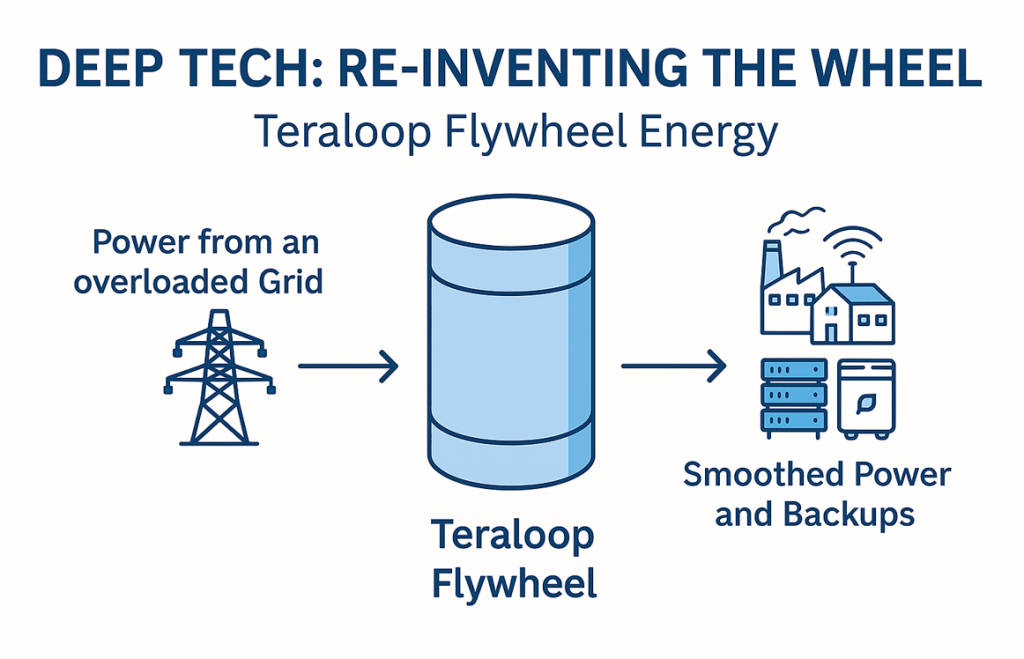
Teraloop Oy has recreated the flywheel in carbon fiber. The result is a compact, ultra-reliable power management and back-up system with a lifespan of up to 30 years without degradation – far longer than typical battery solutions.
I visited recently with founder and CCO Ted Ridgway Watt to learn more about flywheels – an ancient solution made new again.
The Teraloop Solution
Teraloop produces a 250kw system, with a 1mw solution to be released next year. Both are compact powerhouses – fitting in less than 1 square meter. These are available as permanent installations or as a “solution in a container,” – a complete system in a box delivered to a factory door or work site. These can be deployed in arrays for larger applications.
The Teraloop flywheels are hub-less, using magnetic levitation for a low friction, low failure, and highly solution. They have a much longer lifespan than battery back-ups – up to 30 years without degradation. This means a great ROI for customers over the long-term. The biggest challenge is often accounting – flywheels have a higher initial capital cost and typical corporate business cases consider only about 3-5 years.
As a Power Backup
When I spoke to Ted, my primary interest was in flywheels as an alternative to batteries and supercapacitors. And the flywheels fare quite well.
- Superior response times (~10ms compared to 110ms-several seconds for batteries)
- Handle rapid charge/discharge cycles from fluctuating grid power – batteries degrade rapidly under these conditions.
But flywheels do eventually wind down – so are often used in compliment with a battery solution for long outages. The flywheel provides rapid response and protects the batteries with extended life.
Interesting Use Cases
That buffering is one of the primary advantages of the flywheel solution.
- Grid Buffering – Smoothing the power fluctuations from the grid protects sensitive industrial, compute, and smart building installations, extending equipment life and reducing downtime.
- Power Regeneration – Those absorption properties also make the Teraloop solution ideal for cranes, elevators, and even smart buildings. The power capture/discharge can help make the most out of power consumed from a public utility or other source.
- Electric Vehicle Recharging – Valuable especially in remote locations with low-voltage connections. The flywheel spins-up with whatever power is available, and then rapidly discharge to a vehicle. And not just for your Tesla or BYD – think heavy industrial equipment in remote locations (e.g. mining haulers).
Global Reach
A final commercial note – Teraloop is now in partnership with Arteche, the Spanish multi-national power services company. This is a great channel for expanding their reach globally, and should play favorably in their next funding round.
If you would like to learn more about how flywheels can help your business with power management and backup, please reach out to Ted Ridgway Watt or Silvano Saggioro

 MNJ Ventures LLC