One certain trend in tech? Escalating compute demand.
AI, High-performance compute (HPC), cryptocurrency and IoT are all driving the need for denser racks and more power… creating more heat, more noise, and more cooling challenges.
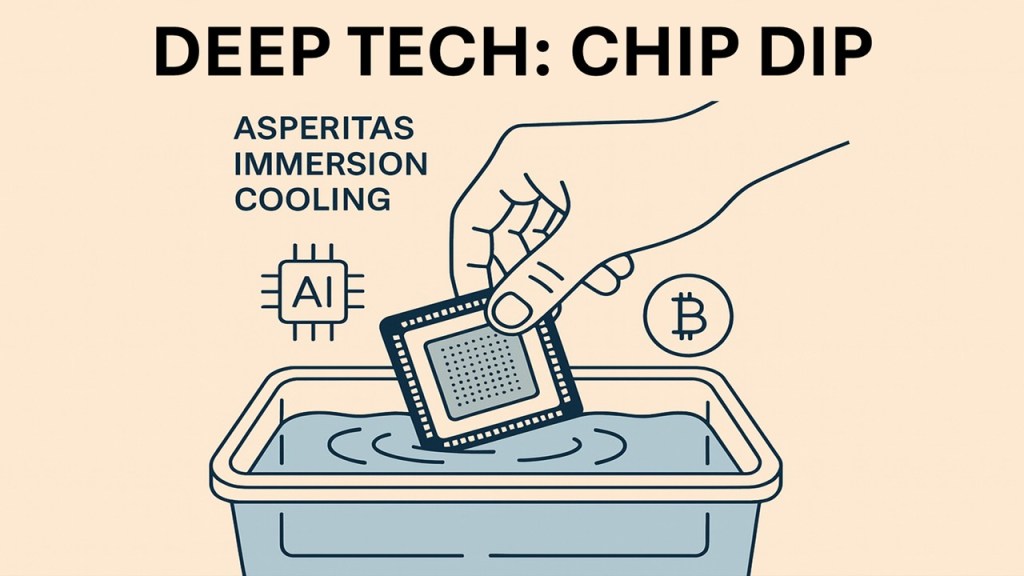
Immersion cooling for high-end servers is an emerging solution.* Yes, it means dunking entire server racks – not in water, but in engineered dielectric fluids that conduct heat, but not electricity. It is a promising approach for cooling that can slash energy needs by 95%.
*Immersion? solution? Yes, the pun was intended 😉
Immersion cooling is still early-stage (less than 10% penetration) it is hitting an inflection point. Leading chips from NVIDIA, Intel, AMD, Dell, HPE and others are all engineered to be immersion-ready. In fact, immersion cooling is becoming the go-to approach for racks that exceed ~50 kW.
I recently met with Rutger de Haij, the CEO of Asperitas , one of the leaders in immersion cooling. Rutger’s journey to CEO is a story that’s worthy of a pint in a pub, but for this article I’ll stick to business highlights (paraphrased for brevity).
———————————–
When there is a gold rush, it’s a great time to sell shovels.
Why do you think Asperitas is positioned well?
Right now in datacenters, power is everything. The question is how to you monetize it in the best way? Operators want to maximize compute per watt and per square meter.
Asperitas helps our customers reduce power for cooling, freeing it for more compute. And the compact nature of our solution allows for better use of datacenter floorspace.
Demand is only growing. The EU’s Digital Decade initiative aims to deploy 10,000 edge nodes to boost sovereignty and reduce latency. Add in ambitious sustainability goals, and the case for immersion cooling becomes even stronger.
And as the saying goes, when there is a gold rush, it’s a great time to sell shovels.
It’s not the tech – it’s the terms.
Adopting new infrastructure is never easy, especially with multi-million dollar investments on the line. How do you overcome that inherent conservatism?
Establishing ecosystem standards will help. Asperitas has taken a leadership role in shaping standards through platforms like ASHRAE and OCP. These help the whole ecosystem mature and adoption increase.
Surprisingly, the tech standards aren’t the hard part – it is the terms. For example, negotiating warranties take much longer. The business processes need to change too.
Cheering for the Competition too
There is competition in this space. GRC has a solution, Submer is building their own datacenters, and the hyper-scalers are building their own solutions. So why Asperitas?
First, we have a great solution, with very efficient natural convection cooling, powered cooling, and a full set of tools for service. In fact, our solutions work even in remote harsh desert or jungle environments. Our immersion solution allows the racks to be more densely stacked, protects the equipment from dust, and naturally operates well in hotter climate conditions.
Some of our competitors are going a different route, building their own immersion-cooled datacenters. That may not work for – and may even compete with – some customers. Our approach gives both enterprise and edge clients control for a wide range of digital assets and environments.
What about the hyper-scalers?
They often build their own solutions – even chips. But their scale and growth is so fast that there is also room for many suppliers. They are an opportunity, not a threat.
You know, I cheer when our competition wins work. At this stage of the game, the more market adoption we have for immersion cooling, the better off we all are.
———————————–
Rutger and I discussed several other topics – target markets, product roadmap, chip temperature-performance gradients, and more. But that’s enough for today!
If you’d like to learn more on the topic or the company, Maikel Bouricius at Asperitas.

 MNJ Ventures LLC